May 22, 2026 • Thiên-Anh Roussel • 9 min reading time • Prices verified June 18, 2026
Getting the Most from a $15–$25 Ramekin Set: Porcelain Quality, Glaze, and What to Ignore
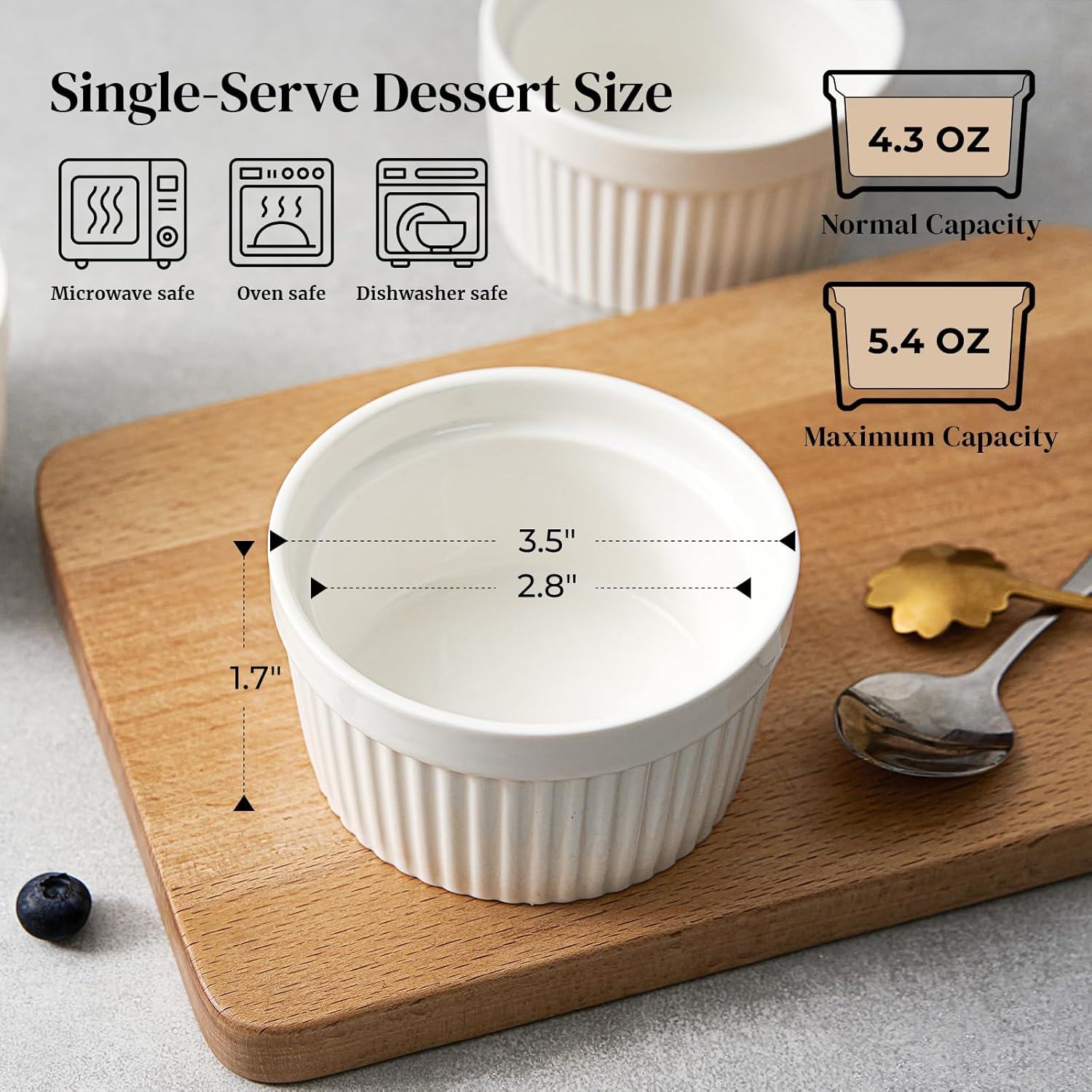
If you’re just starting to bake soufflés — or you need a set of small oven-safe dishes (called ramekins) for crème brûlée, individual pot pies, or mise en place prep — the $15–$25 price tier is genuinely worth your time. A ramekin is simply a straight-sided, oven-safe dish, typically 4 to 8 ounces in capacity, designed to go from the oven directly to the table. They’re the workhorses of French home baking. The question isn’t whether budget ramekins can do the job — many can — it’s knowing which ones are actually made well and which ones are dressed up to look the part. This guide walks you through the quality signals that matter, the specs you can safely ignore, and a clear decision rule for when spending more is actually worth it.
| EDITOR'S PICK[Mora Ceramic Ramekins - 8oz](https://www.amazon.com/dp/B09F8PXH8F?tag=greenflower20-20) | Mid-tier[BTaT- Ramekins](https://www.amazon.com/dp/B07YNY46XZ?tag=greenflower20-20) | Budget pick[LE TAUCI Ramekins 4 OZ Oven Safe](https://www.amazon.com/dp/B0C5X79PTQ?tag=greenflower20-20) | |
|---|---|---|---|
| Capacity | 8 oz | 8 oz | 4 oz |
| Set Size | 6 | 8 | 6 |
| Measurement Markings | ✗ | ✓ | ✗ |
| Price | $29.99 | $18.99 | $13.99 |
| See on Amazon → | See on Amazon → | See on Amazon → |
What “Porcelain” Actually Means at This Price Point
The word porcelain gets used loosely on product listings, so let’s pin it down. True porcelain (sometimes called hard-paste porcelain) is fired at very high temperatures — typically above 2,300°F — which vitrifies the clay body, meaning the material fuses into something non-porous and glass-like all the way through. That’s why quality porcelain doesn’t absorb odors or stain, rings clearly when tapped, and feels dense relative to its size.
At the $15–$25 price point, you’ll see three materials competing under the same label:
True vitrified porcelain — the real thing. Fired hot, dense, non-porous, smooth on unglazed edges. This exists in the budget tier; it’s just less common.
Earthenware or low-fire ceramic marketed as porcelain — typically lighter, more porous, and prone to absorbing liquid into the clay body over time if the glaze ever crazes (develops hairline cracks). The Kitchn’s materials explainer on porcelain vs. stoneware vs. ceramic notes that the distinction is almost entirely about firing temperature and clay composition — and that the word “ceramic” on a listing tells you almost nothing useful by itself.
Stoneware — technically a different category, fired at medium-high temperatures. Denser than earthenware but not as fully vitrified as porcelain. Legitimate for ramekins and widely used, but not the same as porcelain in terms of thermal behavior.
The practical difference for soufflé baking: true porcelain conducts and releases heat more evenly than low-fire earthenware, which can create hot spots that set the batter unevenly before the steam has a chance to drive the rise. Food52’s buyer’s guide on ramekins consistently flags this as the primary reason to care about material at all — it’s not aesthetics, it’s bake behavior.
How to spot true porcelain on a listing without touching the piece:
- Weight listed per ramekin above 7–8 oz for a 6-oz capacity dish (dense = vitrified)
- Unglazed foot ring described as smooth or “fine-grained” — coarse or sandy foot rings signal lower-fire earthenware
- Manufacturer country: French and Japanese-made porcelain in this tier (brands like HIC and certain BIA Cordon Bleu runs) tend to hold spec; some lower-tier imports do not
Glaze Quality: The One Spec That Actually Predicts Longevity
Glaze on a ramekin serves two functions: it seals the clay body (especially important on lower-fire pieces) and it determines how the dish performs oven-to-table, including whether it crazes, chips, or picks up staining over repeated use.
At $15–$25, glaze quality separates the sets that last five years from the ones that look tired after a season of regular use.
What crazing is and why it matters: Crazing is the network of hairline cracks that develop in a glaze when the glaze and the clay body expand and contract at different rates during heating and cooling. On fully vitrified porcelain, crazing is mostly cosmetic — the underlying clay body is non-porous, so nothing penetrates. On earthenware or low-fire ceramics, crazed glaze exposes a porous body that absorbs fats, aromatics, and moisture. That’s when ramekins start to smell off even after washing.
America’s Test Kitchen’s ramekin equipment notes (published in Cook’s Illustrated) call out glaze thickness and evenness as the leading predictor of crazing resistance in sub-$30 pieces. Thin glaze applied in a single coat, especially on the interior walls and near the rim, is the failure point they see most.
What to look for:
- Glaze that extends fully to the foot ring edge, or a clearly intentional unglazed foot (a design choice, not a cost-cut)
- Described as dishwasher-safe AND oven-safe to at least 500°F — both together suggest the glaze has been formulated for thermal cycling, not just appearance
- Matte or semi-matte interior glazes tend to show crazing earlier than high-gloss finishes because they’re often thinner; this isn’t a rule, but it’s a pattern worth noting in reviews
What crazing looks like in aggregate reviews: Serious Eats’ ramekin review explicitly tracked which sets showed crazing within the first six months of regular oven use. Sets with thicker, consistently applied high-fire glaze — even at lower price points — held up; sets where reviewers noted “fine lines appearing after dishwasher use” were the low-fire tells.
By the Numbers
| Price tier | Firing temp (typical) | Glaze cycles before crazing risk | Oven-safe temp rating |
|---|---|---|---|
| $15–$25 porcelain (quality) | 2,300°F+ | 200–400+ cycles | 500°F |
| $15–$25 earthenware (mislabeled) | 1,800–2,000°F | 50–150 cycles | 400–450°F |
| $35–$55 mid-tier (HIC, BIA) | 2,300°F+ | 400+ cycles | 500°F+ |
| $85–$95 Emile Henry Grand Cru | Proprietary HR ceramic | 500+ cycles | 570°F |
Cycle estimates based on manufacturer ratings and aggregated owner reviews; individual results vary by use pattern and dishwasher temperature.
What You Can Safely Ignore at This Price
This is where a lot of buyers waste mental energy. Here are the specs that appear in listings and reviews that do not materially affect soufflé performance or long-term value in the $15–$25 tier:
Lid compatibility. Ramekins don’t need lids for soufflés, crème brûlée, or most individual baked preparations. Listings that emphasize included lids are usually optimizing for storage or meal-prep use cases — not relevant to baking performance.
Color options. White is the standard for a reason (it reads as neutral oven-to-table and doesn’t influence perceived browning), but colored ramekins from quality porcelain manufacturers perform identically. The glaze formulation matters; the pigment doesn’t.
Microwave-safe ratings. If you’re using ramekins for soufflés, the microwave question is irrelevant. For other uses, most porcelain is microwave-safe unless it has metallic trim — but this spec doesn’t tell you anything about oven performance or glaze durability.
Stack-ability. Nice to have for storage. Zero impact on bake outcome.
Embossed or fluted exterior pattern. Purely aesthetic. Straight-sided interior geometry — meaning the interior wall runs perpendicular to the base with no inward or outward slope — is the functional spec. A ramekin with a decorative exterior can still have correct interior geometry. Conversely, some plain-looking ramekins have slightly sloped interiors that redirect the batter’s rise. Always check the interior profile, not the exterior decoration.
Food52’s buyer’s guide flags interior wall geometry as the one aesthetic-adjacent spec that crosses into function: a true straight-wall interior creates an even column of batter that rises vertically. Any inward taper at the rim pinches the rise; any outward flare reduces the driving pressure. For a soufflé, you want a cylinder, not a cup.
The Sets Worth Taking Seriously in This Range
Without endorsing specific SKUs that may have shifted between production runs, the brands that reviewers at Serious Eats and America’s Test Kitchen consistently return to in the sub-$25 range share a few characteristics: they’re made to food-service spec (meaning they’re designed for repeated thermal cycling, not one-time gifting), they carry an honest oven-safe rating of 500°F or higher, and they show up with consistent glaze coverage in owner photos rather than the thin, uneven application that flags lower-fire production.
HIC Harold Import Co.’s porcelain ramekin line appears repeatedly in this context — the 6-oz straight-sided set routinely prices between $18–$28 for a set of four and is manufactured to a vitrified porcelain spec. Reviewers note the glaze holds well across dishwasher cycles, which is the most reliable proxy for thermal cycling durability available without lab testing.
BIA Cordon Bleu’s porcelain pieces occupy a similar position: genuine vitrified porcelain, consistent interior geometry, and a track record in owner reviews of resisting crazing over multi-year use.
If you’re sourcing from unfamiliar brands — especially through general marketplace listings — the decision framework is simple: look for an unglazed foot ring that feels smooth and fine-grained (not gritty), a stated oven-safe temperature of 500°F minimum, and aggregate reviews that don’t mention “cracks appearing” or “lines in the glaze” within the first year. Those are the red flags that identify low-fire earthenware regardless of what the listing says.
The Clear Decision Rule
If you’re deciding whether to stay in the $15–$25 tier or move up:
Stay in this tier if you’re building a working set for regular practice baking — soufflés two or three times a month, crème brûlée for dinner parties, individual gratins. A quality vitrified porcelain ramekin at $4–$6 per piece performs the bake competently, holds up to regular thermal cycling, and presents cleanly at the table. The functional gap between a $5 HIC ramekin and a $22 Emile Henry individual ramekin is narrow for most home applications.
Move up if you’re baking for guests in a context where oven-to-table presentation is part of the experience — the dish is arriving at the table still in the ramekin, and the visual read matters — or if you’re building a set you expect to use professionally or semi-professionally for five-plus years. The mid-tier ($35–$55) and premium tier ($85+) earn their price through glaze durability over hundreds of cycles, more refined wall geometry, and frankly better table presence. That’s a real return on the additional spend; it’s just not necessary at the practice-baking stage.
Never buy in this tier if the listing can’t confirm vitrified porcelain (not “ceramic”), doesn’t state an oven-safe temp of 500°F or higher, or if the interior profile appears tapered in product photos. The $15–$25 range has genuinely good options — but it also has a lot of noise, and the noise comes in the same box.
The soufflé doesn’t care about the price of the dish. It cares about straight walls, even heat, and glaze that won’t absorb yesterday’s custard into tonight’s chocolate rise. Get those three things right, and the tier almost doesn’t matter.