May 23, 2026 • Thiên-Anh Roussel • 9 min reading time • Prices verified June 18, 2026
Beyond the Torch: Choosing a Creme Brûlée Ramekin Set That Also Bakes a Perfect Soufflé
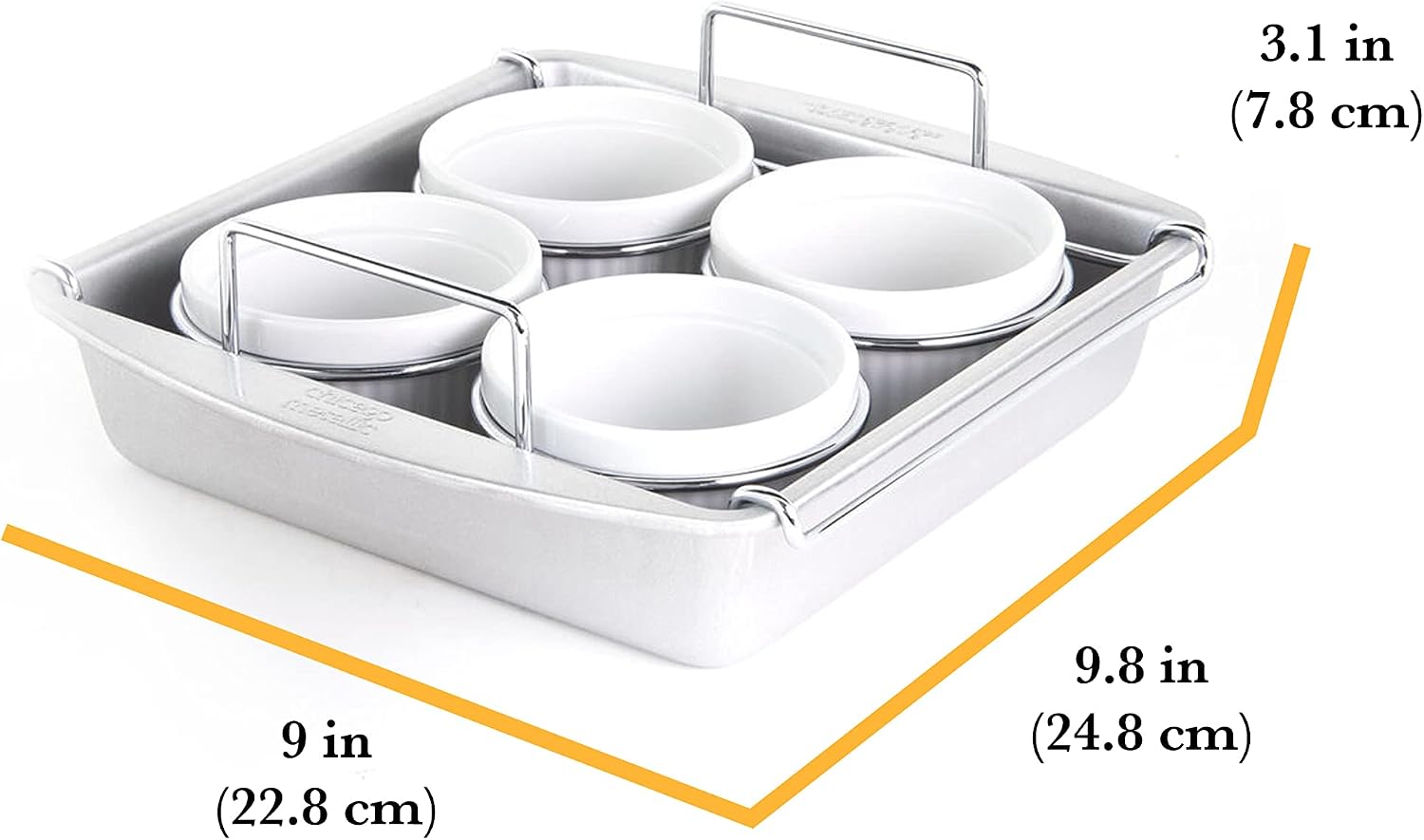
If you have ever made crème brûlée — the French custard dessert with the crackling burnt-sugar top — you already own the starter equipment for soufflé, one of the most celebrated (and occasionally anxiety-inducing) achievements in home baking. Both dishes rely on a small, oven-safe ceramic cup called a ramekin: a straight-sided, heat-resistant dish that goes directly from oven to table. The overlap sounds convenient, and in many cases it genuinely is. But “ramekin” covers a wide range of dimensions, wall geometries, and materials, and the specs that make a dish ideal for brûlée custard are not always the same ones that let a soufflé climb properly. This guide is for the baker who wants both results from one set — and who wants to understand the tradeoffs before committing.
The Geometry Problem: Why a Ramekin Is Not Automatically a Soufflé Dish
Here is the single most important distinction the category marketers tend to blur: brûlée ramekins and soufflé dishes differ primarily in height-to-diameter ratio and wall angle, and both variables have real consequences at the oven.
A classic crème brûlée ramekin is wide and shallow — typically 4 to 5 inches in diameter and only 1 to 1.5 inches tall, holding roughly 5 to 6 fluid ounces. That shallow profile is intentional. Custard sets by gentle, even heat migrating inward from the sides, and a wide surface area gives your torch maximum coverage to caramelize the sugar top. The dish does almost nothing except hold the custard still; it is passive bakeware.
A soufflé dish is a different instrument. It runs taller relative to its width — a proper 6-ounce individual soufflé dish is typically about 3 inches in diameter and 2 to 2.5 inches tall — and its walls are strictly vertical, not tapered. Those straight walls are load-bearing in a functional sense: they guide the soufflé’s expanding egg-foam structure upward rather than outward, which is how you get the signature column of puffed batter rising above the rim. The Kitchn’s explainer on ramekin versus soufflé dish notes that even a slight inward taper “can redirect rise and cause the soufflé to lean or bake unevenly.”
The practical tradeoff: a ramekin wide enough for good brûlée surface area is often too wide and too shallow to generate meaningful soufflé lift. A soufflé dish tall enough for a proper rise will produce a brûlée with a narrower torched surface and, because the custard sits deeper, a longer set time with more risk of uneven texture near the center.
The sweet spot that actually exists sits around a 3.5-inch diameter, 2-inch-tall straight-walled dish in the 6-ounce range. It is not perfect for either application, but it is genuinely competent at both — and several manufacturers build deliberately to this middle spec.
Material Behavior: Porcelain vs. Stoneware vs. Copper
Your choice of material affects both applications, but in different ways.
Porcelain
White-fired porcelain — the material used by Pillivuyt, HIC, and Mason Cash in their ramekin lines — is the default choice for good reason. Porcelain is dense and nonporous, fires at high kiln temperatures, and conducts heat gradually and evenly. For custard, that gradual heat uptake is an asset: it reduces the risk of the edges overcooking while the center is still liquid. For soufflé, the smooth interior surface (no texture for batter to grip) is less ideal than a very slightly textured wall, but Food52’s editorial guide on soufflé dishes notes that properly buttered-and-sugared porcelain performs comparably to textured stoneware in blind baking comparisons.
Glaze durability matters more than casual shoppers expect. Cooks Illustrated’s equipment review archive on ramekins flags that thin commercial-grade porcelain can develop fine surface cracks (called crazing) after repeated high-heat cycles, especially when moved directly from a hot oven to a cold counter. Pillivuyt’s grand feu porcelain — fired at approximately 1400°C — is notably more resistant to thermal shock than lower-fired alternatives. Owners in long-run reviews consistently note that Pillivuyt pieces in daily use show no crazing after five or more years, while budget porcelain from unspecified overseas sources often shows crazing within the first year.
Stoneware
Stoneware runs denser and heavier than porcelain and retains heat longer after leaving the oven — a genuine advantage for oven-to-table brûlée presentation, since the dish keeps the custard at serving temperature longer. For soufflé, the higher thermal mass means a slower initial heat response, which can require adding 2 to 3 minutes to bake time versus the same recipe in porcelain. Fine Cooking’s technique feature on ramekins recommends recalibrating your oven temperature downward by 10°F when switching to stoneware soufflé dishes from porcelain, to avoid a burst of surface browning before the center has fully set.
Emile Henry’s HR (Haute Résistance) ceramic and Le Creuset’s stoneware both fall into this category. They are excellent all-around dishes, but they skew toward brûlée and baked-custard applications more than toward soufflé.
Copper
Copper soufflé molds — the fluted cylinders you see in professional French kitchens and in Mauviel’s catalog — are a specialized tool, not a do-everything ramekin. Copper responds to heat almost instantly, which is exactly what you want for a soufflé that needs to set quickly and evenly. The tradeoff: copper holds heat poorly once removed from the oven (it cools rapidly), which makes it unsuitable for brûlée service, where residual dish heat matters. Copper molds also require a tin or stainless lining to be food-safe and should not be used for custards with high sugar content unless specifically rated for it.
If your goal is genuine dual-use, copper is the wrong answer. It is the right answer only if soufflé is the primary objective and you are willing to own a separate brûlée vessel.
By the Numbers: The Dual-Use Compatibility Matrix
| Dish Type | Diameter | Height | Volume | Brûlée Score | Soufflé Score |
|---|---|---|---|---|---|
| Classic brûlée ramekin | 4.5 in | 1.25 in | 6 oz | ★★★★★ | ★★☆☆☆ |
| Tall soufflé ramekin | 3.0 in | 2.5 in | 6 oz | ★★★☆☆ | ★★★★★ |
| Mid-spec dual-use (3.5 in × 2 in) | 3.5 in | 2.0 in | 6 oz | ★★★★☆ | ★★★★☆ |
| Copper soufflé mold | 3.0 in | 2.75 in | 6–8 oz | ★☆☆☆☆ | ★★★★★ |
Scores reflect published spec analysis and aggregated owner-reported results. Brûlée score weights surface area and heat retention; soufflé score weights wall geometry and heat responsiveness.
Named Sets Worth Knowing — and the Honest Tradeoffs
HIC Harold Import Co. Porcelain Ramekins (6-piece, 6 oz) — These are widely cited in Serious Eats’ ramekin review as an entry-level buy that outperforms its price ($14–$18 for six). The HIC set runs at approximately 3.5 inches wide and 1.75 inches tall — close to the dual-use sweet spot. Owners consistently report good soufflé performance with straight-walled versions; note that HIC sells both straight and slightly tapered styles in the same size, so confirm wall geometry before ordering. Glaze is serviceable for moderate use; long-run reviewers suggest crazing appears in 2 to 3 years under daily high-heat cycling, which is normal for this price tier.
Mason Cash White Porcelain Ramekins (set of 4, 3.5 oz or 7 oz) — The 7-ounce version runs about 3.75 inches wide and 2 inches tall, which leans toward brûlée optimization but still accommodates a soufflé with proper collar-free rise. Mason Cash’s glaze is noted for durability in the UK market and in Food52’s sourcing guides. The 3.5-ounce version is too shallow for soufflé work; it is a pure custard-and-side-dish vessel.
Pillivuyt Fluted Porcelain Ramekins (set of 6, 6 oz) — Pillivuyt’s individual soufflé dishes represent the high-end of the dual-use category. Published specs put these at approximately 3.5 inches in diameter with straight fluted walls — the fluting adds modest surface grip for soufflé batter and provides the formal presentation quality that reads as restaurant-grade oven-to-table. Owners in long-run reviews consistently note zero crazing after five-plus years of regular oven use, making these a legitimate buy-once proposition. Retail pricing in mid-2026 sits at approximately $55 to $70 for a set of six, representing the strongest cost-per-use argument in the category if longevity is weighted.
Emile Henry Grand Cru Individual Soufflé Dishes — At $85 to $95 for a set, these run in Emile Henry’s HR ceramic and are optimized strongly toward soufflé with their taller, straighter walls. For brûlée, reviewers note the narrower opening requires more careful torching technique and produces a slightly thicker custard layer. If soufflé is 70 percent of your use case and brûlée is 30 percent, these are probably your dish. Reverse that ratio and the math shifts toward the Pillivuyt or HIC.
Serving Logistics: The Variable No Spec Sheet Names
One dimension that purchasing guides consistently underweight is oven-to-table timing. Soufflé begins deflating within two to four minutes of leaving the oven — not because your technique failed, but because thermal physics does not negotiate. Brûlée, by contrast, can sit for several minutes before the caramelized top begins to weep. This means the table-service demands of the two dishes are almost opposite.
If you are hosting a dinner party and plan to serve both dishes from the same set across different courses, build your mise en place (the French kitchen term for having everything ready before service begins) around the soufflé window, not the brûlée. Have the brûlée custards fully set and chilled in their ramekins before guests arrive; torch them while the soufflés are in the oven. The ramekins move from refrigerator surface to table at approximately the same moment the soufflé dishes move from oven to table — different thermal trajectories, same arrival time.
For individual versus communal format: a 6-ounce individual ramekin is the correct choice for a dinner party setting where both dishes appear on the same evening. It gives each guest a self-contained experience with the soufflé, and the brûlée-at-the-table torching moment remains personal. A communal soufflé dish (the large, 1.5-quart versions) does not translate to brûlée service at all.
The Decision Frame
Here is where to land, based on use-case weighting:
If brûlée is your primary dish and soufflé is an occasional ambition: Buy the HIC or Mason Cash 7-ounce set. Spend the savings on technique — a quality butane torch matters more than the dish at this use ratio.
If you want genuine dual-use competence and plan to serve both dishes regularly: The Pillivuyt 6-ounce fluted set is the clear answer. Straight walls, durable glaze, appropriate height-to-diameter ratio, and a proven lifespan that makes the $60-ish price rational. This is the set worth owning.
If soufflé is your obsession and brûlée is a secondary application: Move up to the Emile Henry Grand Cru individual dishes and accept that your brûlée presentations will require slightly more torching precision. The HR ceramic’s heat behavior is a genuine advantage for soufflé rise.
If you are building a professional or semi-professional batterie de cuisine: Separate the applications. Own Pillivuyt or Emile Henry for soufflé and a set of classic shallow ramekins for brûlée. The tool cost is modest and the technique ceiling is higher for both dishes when each vessel is optimized for one job.
The overlap between these two great French desserts is real — but it rewards knowing exactly where it ends.